The Ingredient Most Cover Letters Are Missing — And It's Not About You
Most applicants write about themselves. The best applicants write about the world they're entering. Context — the job, the industry, the megatrends — is the missing ingredient that turns a generic letter into a strategic one.
TL;DR
Your cover letter isn't a monologue about your skills. It's a connection between two inputs: who you are and where you're going. Without understanding the context — the megatrends shaping the industry, the organisation's position, the real problem behind the hire — you're writing into a void. StoryLenses extracts 15+ context fields from every job description automatically, turning hours of research into the foundation of a narrative that connects.
It's Not About You
Here is the most counterintuitive thing about cover letters: the most powerful ingredient has nothing to do with your skills, your experience, or your qualifications. It is about their world.
Simon Sinek's Golden Circle explains why. Most applicants start from the outside — the What. "Here is what I can do. Here are my skills. Here is my experience." It is the default mode because it feels safe. You know your own CV.
But the strongest narratives start from the centre — the Why. "Here is why this context matters to me. Here is why this industry is where I want to build my career. Here is why your organisation's mission resonates with the trajectory I have been on for years."
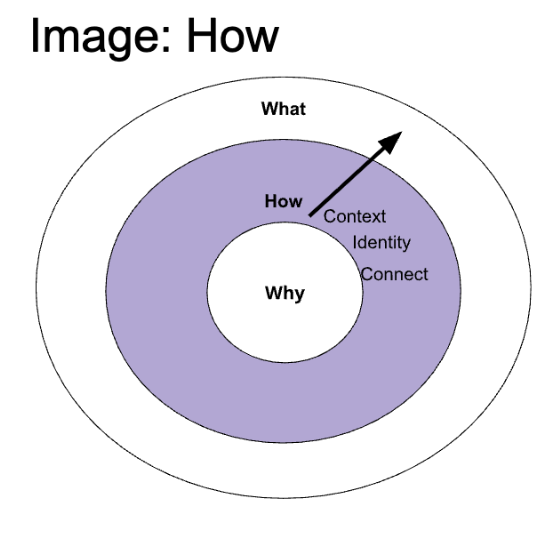
Context is the missing ingredient. Without it, you are just another applicant listing qualifications. With it, you are someone who understands the world you are asking to enter — and that changes everything about how your letter reads.
The Story Frame: Context + You = Connection
A cover letter is not a monologue. It is a connection between two inputs: Context Info and You. Context Info is everything about the job, the organisation, the industry, and the trends shaping them. You is your experience, your values, your trajectory. Neither input alone produces a compelling narrative.
The flow looks like this: Context Info and You feed into a Connection — the overlap where your story meets their reality. That Connection flows through a Story Structure and produces your outputs: a Story, a Resume, and a Cover Letter. Without context, there is nothing to connect to. You are talking into a void, hoping something lands.
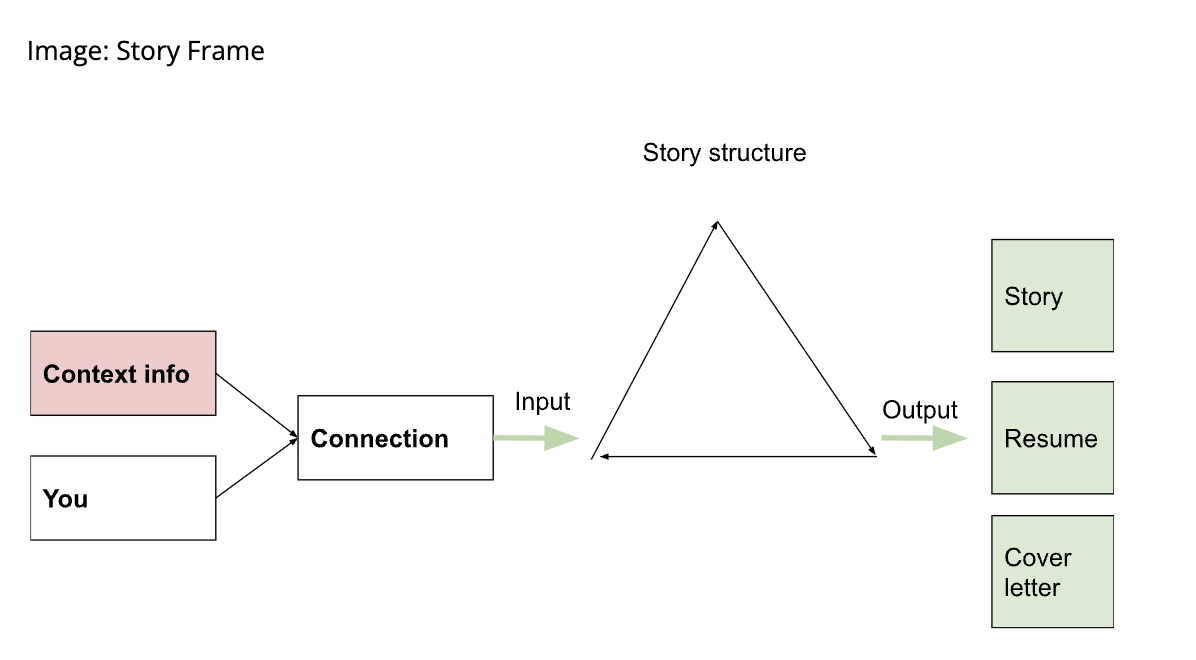
The strongest applicants understand this intuitively. They do not write about themselves in isolation. They write about the intersection — the place where who they are meets where the organisation is going. That intersection is where hiring decisions happen.
Zoom Out Before You Zoom In
Most people start and stop at the job description. They read the requirements, match their skills, and start writing. That is zooming in without ever zooming out.
The real context has nested layers: Megatrend → Industry → Organisation → Job, each unfolding across Past → Present → Future. The strongest applicants understand the megatrend making this role exist — digitalisation, sustainability, demographic shifts, AI transformation. They grasp the industry dynamics — who is growing, who is consolidating, where the competitive pressure sits. They research the organisation's position — its strategy, its challenges, its trajectory. And only then do they zoom in to where the specific job sits within all of it.
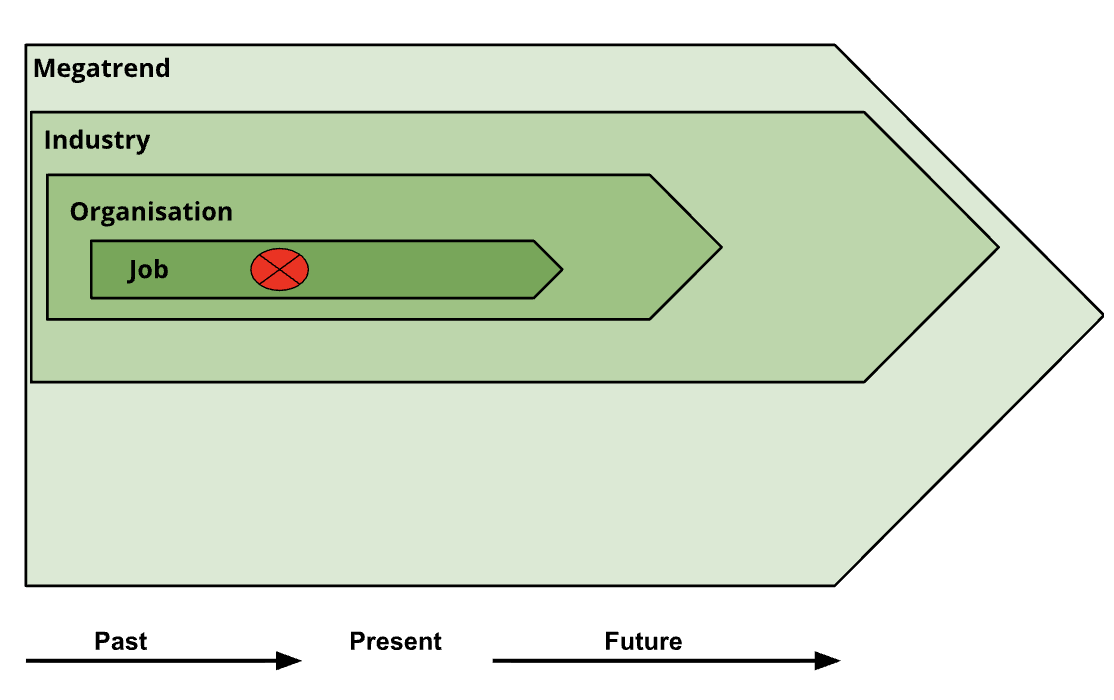
Why does this matter? Five reasons:
- Filter: Is this really the industry and organisation you want? Proper research saves you from applying to roles you would regret accepting. Time invested in context research is time saved on dead-end applications.
- Pro-argument: Deeper understanding gives you stronger positioning. When you can articulate why this industry is growing and why this organisation is well-placed within it, your argument for joining becomes inherently more persuasive.
- Implicit signal: You demonstrate oversight and attention to detail without having to claim it. Recruiters notice when someone understands the bigger picture — it signals seniority, strategic thinking, and genuine interest.
- Essential for matching: You cannot explain a match without understanding what you are matching with. The connection between your experience and their needs only becomes visible when you understand both sides.
- Connection: Your future employer believes in this context — the megatrend, the industry, the mission. When you articulate that same belief with genuine understanding, you create a connection that no list of skills can replicate.
Find Yourself a Horse to Ride
Al Ries and Jack Trout wrote in Positioning that one of the smartest career moves is finding the right horse to ride — the right company, the right industry, the right trend. You are not just applying for a job. You are choosing a context dynamic. A rising industry, a growing company, a future-proof role. This choice itself is a powerful narrative element.
Think of it like the Puss in Boots fairytale — a story about a cat who understood context, demand, and leverage better than anyone in the room. He did not have the best resources. He had the best reading of the situation. He chose his context consciously and built his entire strategy around it.
Your future employer is in their industry because they believe in it. When you demonstrate that you have chosen this context consciously — that you are not just applying because the job was listed, but because you understand and believe in the trajectory — that resonates. It is the difference between "I saw your posting" and "I have been watching this space for years, and here is why your organisation is where I want to be."
How StoryLenses Does This For You
When you paste a job description into StoryLenses, the system does not just extract a list of requirements. It performs a structured context analysis — the same kind of research that would take you hours to do manually.
The job analysis extracts 15+ structured fields from every posting. Not just hard skills and qualifications, but the company's challenges, cultural signals embedded in the language, the business problem behind the hire, and the competitive dynamics implied by the positioning. It identifies megatrends from the posting language — digitalisation signals, sustainability commitments, growth indicators, transformation markers.
Then the matching engine connects your experience to their context. It does not just look for keyword overlaps. It finds the structural connections — where your past achievements address their current challenges, where your trajectory aligns with their direction, where your values meet their culture.
The narrative is built on this context. Every story StoryLenses generates is anchored in the reality of the role, not floating in a vacuum of generic self-description. This is pillar number one — HR Intelligence — reading the context, not just keywords. What takes hours of manual research, StoryLenses does in seconds. The job analysis step is the context research — automated and structured.
The One Question That Changes Everything
Before you write a single word of your next cover letter, answer this question: What is happening in their world that makes this job exist right now?
If you cannot answer it, you have not done enough context research. You are about to write into a void. Go back. Read the posting again. Research the company. Understand the industry dynamics. Find the megatrend.
If you can answer it — clearly, specifically, with genuine understanding — you have the foundation for a story that connects. Everything else builds on that.
Want to see how your current letter handles context? Try our free Letter Check tool — it evaluates whether your letter demonstrates real understanding of the role or just lists skills in a vacuum. Or skip ahead and create a story with StoryLenses, where context research is built into the process from the very first step.
Ready to try it yourself?
Create a professional, tailored cover letter in minutes.
Write Your First Cover Letter →