The Lego Piece Problem — Why 102 Million Combinations Mean You Must Own Your Story
Your CV is a box of Lego bricks. If you don't build the model yourself, the recruiter will — and their version probably won't look like you intended.
TL;DR
Six identical Lego bricks can be combined in over 102 million ways — and your CV has far more than six pieces. If you do not assemble your own narrative, the recruiter will build one from your raw facts, filling gaps with their own assumptions. Own the story or someone else will.
Most professionals believe their CV speaks for itself. That the facts are clear, the experience is obvious, and any reasonable person reading it will arrive at the same conclusion: this candidate is a strong fit.
They are wrong. And a simple Lego experiment proves it.
The information on your CV — your skills, your achievements, your trajectory — those are raw pieces. Lego bricks, if you will. And whoever receives them will assemble their own version of "you." The question is not whether a story gets built from your application. The question is whether you build it, or whether you hand over a box of loose bricks and hope the recruiter builds something flattering.
Your Lego Pieces
Think about everything that forms a recruiter's impression of you. It is far more than your job titles and dates of employment. In any application context, your "pieces" include:
- Skills — technical, soft, domain-specific
- Experience — roles, industries, scale
- Achievements — measurable results, projects delivered
- Defeats — setbacks, lessons, recoveries
- Education — degrees, certifications, training
- Expertise — deep knowledge areas
- Goals — where you are headed
- Philosophy — how you approach work
- Emotions — your passion, your energy
- Expression — how you communicate
- Voice — your tone, formal or conversational
- Style — your professional presence
- Posture — confident, humble, reflective
- Hobbies — what you do outside of work
- Ethnicity and cultural background — the lens through which you see the world
- Assets — network, reputation, portfolio
Each of these is a dimension. Each is a Lego brick that a recruiter could pick up and use to form an impression.
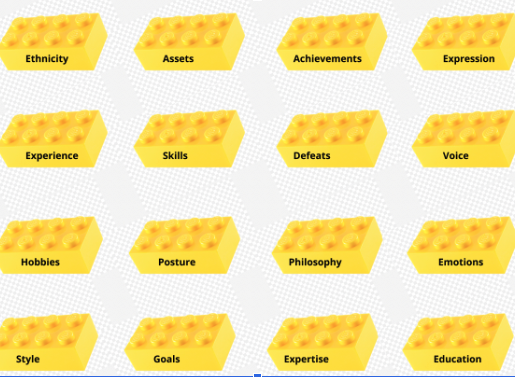
But here is the critical insight: bricks are not a building. A pile of excellent bricks with no instructions and no blueprint can become anything — or nothing coherent at all.
The Curse of Knowledge
There is a well-documented cognitive bias called the Curse of Knowledge. It describes our brain's tendency to assume that others know what we know. Once you possess a piece of information, it is nearly impossible to imagine not knowing it.
This bias is one of the most dangerous traps in job applications.
You look at your CV and see a clear trajectory. You see how that lateral move in 2018 was actually the smartest decision of your career. You see how your three years in operations gave you the foundation for everything that followed. You see the thread connecting your first internship to your current leadership role.
The recruiter sees none of this. They see a list of companies, dates, and bullet points. They see raw Lego bricks. And their brain — because that is what brains do — starts assembling those pieces into a story. But it is their story, built from their experience and assumptions, not yours.
Gestalt psychology, pioneered by Max Wertheimer, Kurt Koffka, and Wolfgang Kohler, established a principle that applies directly here: there is no objective reality in perception. Missing information is filled in by the observer's own experience. When your CV has gaps — not employment gaps, but narrative gaps — the recruiter's brain fills them in automatically. And you have zero control over what it fills in.
The Truth Bias — Your Secret Ally
Here is the encouraging counterpoint. While the Curse of Knowledge works against you when you stay silent, another cognitive bias works powerfully in your favor when you speak up: the Truth Bias.
Research in communication psychology shows that humans have a natural inclination to believe what others tell them. We default to assuming communication is truthful. This is not naivety — it is a deeply wired social mechanism that enables cooperation and trust.
What does this mean for your application? It means that if you invest the effort to tell your professional story clearly, specifically, and with conviction, there is a high likelihood the recruiter will believe it. Not because they are gullible, but because their brain is wired to accept well-constructed narratives as credible.
The catch: you have to actually tell the story. The Truth Bias only activates when there is a narrative to evaluate. A pile of bullet points does not trigger it. A compelling, structured account of who you are and why you do what you do? That activates every trust-building mechanism the human brain has.
The Lego Duck Experiment
For years, I kicked off workshops and team meetings with a simple exercise. I handed every participant the same six Lego bricks — identical pieces, same colors — and gave them one instruction: build a duck.
No further guidance. No picture to follow. Just six bricks and a goal.
Over the years, more than 40 different people did this exercise. Not a single duck was the same.
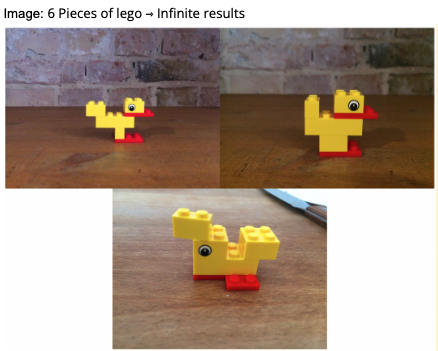
Some were tall and abstract. Some were flat and wide. Some vaguely resembled a duck. Some looked like nothing recognizable at all. A few were genuinely creative. All of them were built from the exact same pieces.
The math behind this is staggering. According to mathematical research, six standard 2x4 Lego bricks of the same color can be combined in 102,981,500 different ways. Over 102 million possibilities — from just six identical pieces.
Let that number sink in for a moment.
The Moral: 102 Million Versions of You
Now map this back to your application. Each Lego brick in the experiment represents one dimension of you — one skill, one achievement, one trait from the list above. The combination of those pieces is the story.
In the duck experiment, there were only six pieces and already 102 million possible combinations. In a real job application, you have far more than six dimensions. You have dozens — skills, experiences, achievements, personality traits, cultural background, communication style, goals, philosophy. The number of possible stories a recruiter could construct from your raw information is not 102 million. It is astronomically higher.
And here is the uncomfortable truth: every recruiter who reads your CV builds one of those combinations. Their brain cannot help it. It takes the pieces you provide, fills in whatever is missing with assumptions drawn from their own experience, and assembles a version of "you" that may or may not resemble who you actually are.
Some recruiters will build a flattering version. Others will build a confused one. Some will build a version that misses your strongest qualities entirely, simply because they picked up the wrong pieces first. You are leaving your professional narrative to a random number generator with 102 million possible outputs.
Start with Why
Simon Sinek's research on the Golden Circle offers a framework that applies directly to this problem.
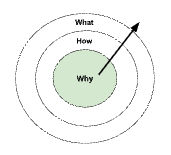
His core insight: people don't buy what you do. They buy why you do it.
The same principle governs hiring. Recruiters do not hire what you have done. They hire the narrative of why you have done it. Two candidates can have identical CVs — same companies, same roles, same years of experience — and one will be compelling while the other is forgettable. The difference is never the facts. The difference is always the story those facts are embedded in.
When you start with your "why" — why you chose this career path, why this particular challenge excites you, why your specific combination of experiences makes you see problems differently — the "what" and "how" become far more powerful. The recruiter stops assembling random Lego ducks and starts seeing the specific, intentional model you built.
Without the "why," your achievements are data points. With the "why," they are evidence in a compelling argument.
Your Brain Was Built for This
If you have read our companion article, The Science Behind StoryLenses, you know the neuroscience that backs this up. Uri Hasson's research on neural coupling showed that when someone tells a story, the listener's brain activity begins to mirror the storyteller's. The better the story, the tighter the synchronization. Paul Zak's work on oxytocin demonstrated that well-structured narratives — with tension and resolution — chemically prime the reader to trust the storyteller.
And then there is the Stanford research showing that stories are 22 times more memorable than facts alone. Twenty-two times. Your three bullet points about project management will fade from a recruiter's memory before they finish their morning coffee. A story about why you became obsessed with solving operational bottlenecks after watching a team you cared about burn out from inefficiency? That sticks.
As Carl Alviani put it: "Our brains are hardwired for narrative." Not for bullet points. Not for keyword lists. Not for reverse-chronological employment histories. For stories — with a beginning, a middle, a point, and a reason to care.
This is not a nice-to-have insight. It is the fundamental mechanism by which one human being decides to trust another. And a job application is, at its core, a trust decision.
The Missing-Information Trap
Let us bring this full circle. You now understand three forces at work in every job application:
- The Curse of Knowledge — you assume the recruiter sees what you see. They do not.
- Gestalt perception — missing information is filled in by the reader's own experience, not yours.
- The combinatorial explosion — with dozens of "pieces" and no guiding narrative, the number of possible impressions is effectively infinite.
Together, these forces create what we call the missing-information trap. You provide raw pieces. The recruiter's brain fills in the gaps. The result is a version of you that you did not write, did not review, and cannot control.
The only way out of this trap is to build the model yourself. To take your Lego pieces — all of them, including the ones you take for granted — and assemble them into a deliberate, specific, compelling narrative that leaves no room for random interpretation.
Building Your Model
Crafting your story of being the strongest match for a specific role is not vanity. It is strategy. It is the approach that beats the missing-information trap, bypasses the Curse of Knowledge, and delivers your narrative directly to the recruiter's brain in the format their neurology is wired to receive.
This means going beyond listing what you have done. It means answering the questions no CV answers on its own: Why did you make the choices you made? What thread connects your seemingly unrelated experiences? What do you see that others in your field miss? Why does this particular role, at this particular company, at this particular moment, make you lean forward?
When you answer those questions and weave them into a coherent narrative, you are no longer handing the recruiter a box of Lego bricks. You are handing them a finished model — one they can examine, appreciate, and remember. And thanks to the Truth Bias, they are neurologically inclined to believe the story you tell, as long as it is specific, authentic, and grounded in real evidence.
Let StoryLenses Build It with You
This is exactly what StoryLenses was designed to do. The system analyzes your pieces — every skill, every experience, every achievement — and finds the strongest combination for a specific role. It identifies which of your dimensions matter most for this particular job. It surfaces connections you did not see yourself. And it constructs a narrative that is not generic, not templated, but genuinely yours — told through a structure the human brain is built to receive.
You have more than six Lego bricks. You have more than 102 million possible stories. The recruiter will build one of them whether you help or not.
The only question is: will it be the one you intended?
Ready to try it yourself?
Create a professional, tailored cover letter in minutes.
Write Your First Cover Letter →